The African Union (AU) has unveiled a Common African Position on Debt, calling for reforms to the global debt system to speed up debt restructuring while expanding access to concessional financing.
The position paper argues that the current international debt architecture is failing African countries, which has Malawi and other 24 countries either in or at high risk of debt distress, and debt servicing costs surpassing public investments.
The AU is also advocating debt forgiveness on a case-by-case basis where countries can no longer repay because of circumstances beyond their control, saying this is consistent with “the principles of equity, economic justice” and international legal doctrines.
In his accompanying statement, AU Commission chairperson Mahmoud Ali Youssouf said that without decisive action, the debt crisis will continue to erode progress towards the Sustainable Development Goals and Agenda 2063, leaving millions behind.
He urged creditors, multilateral institutions and development partners to heed the call and collaborate with Africa to implement solutions that are just, inclusive and sustainable.
Said Youssouf: “While debt can be a powerful tool for development, over the past decade, the debt burden of many African nations has grown to unsustainable levels, diverting scarce resources from vital investments…
“The stakes could not be higher.”
Beyond debt relief, the AU wants African governments to rely less on expensive external borrowing by strengthening domestic revenue collection, widening tax bases, tackling illicit financial flows and improving public debt management.
It also encourages the use of innovative financing instruments and greater private investment to support development without worsening debt burdens.
AU data show that between 2012 and 2024, the average public debt-to-GDP ratio across African countries increased by about 35 percentage points, rising from 28.8 percent to 65.1 percent of GDP.
Over the same period, debt servicing costs surged by more than 132 percent, resulting in at least 32 African countries allocating a larger share of public expenditure to debt repayments than to essential sectors such as healthcare and education.
For Malawi, which continues to face debt sustainability challenges and limited fiscal space, such reforms could reduce debt servicing pressures and free up resources for public services, infrastructure and economic recovery.
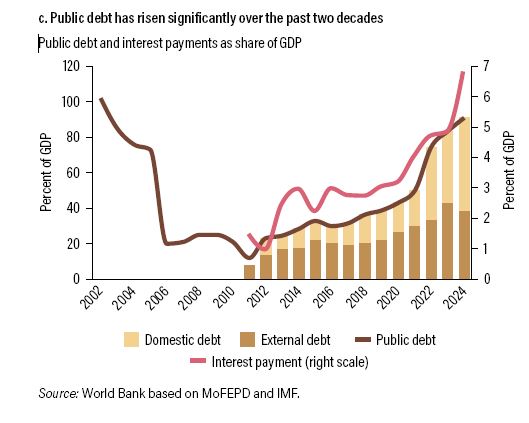
Government data show that Malawi’s public debt stock stood at K23.9 trillion, equivalent to 90.9 percent of gross domestic product, as of December 2025.
Of this amount, 65 percent, or K16 trillion, is domestic debt.
In the current fiscal year ending March 31 2027, public debt interest payments are projected at K2.7 trillion, representing a 22.9 percent increase from the revised K2.2 trillion for the 2025/26 fiscal year, largely due to previously committed debt.
In the 2026/27 Budget Statement, Minister of Finance, Economic Planning and Decentralisation Joseph Mwanamvekha conceded that Malawi’s path towards managing public debt is constrained by the current debt stock. However, he said the 2026/27 National Budget estimates were formulated on the assumption that debt restructuring would create fiscal space.
In its April 2026 Africa Economic Update, the World Bank said Malawi’s debt restructuring, launched in mid-2022, has stalled, with no comprehensive agreement reached following the lapse of the International Monetary Fund programme, leaving the country among the most difficult debt cases in sub-Saharan Africa.
While progress has been made with major bilateral creditors, including China and India, talks with commercial creditors have been slow, according to the Ministry of Finance, Economic Planning and Decentralisation.
The World Bank’s 2025 Debt Sustainability Analysis classified Malawi as being in debt distress, meaning the government is struggling to meet its financial obligations and faces a high risk of default.